Welcome to the Zone of Interest: public statement by Julian Hetzel
Two years ago, the war in Israel and Gaza began – and the world has not been the same since. Two years ago, my daughter was born – and my world has not been the same since.
While my daughter is learning to form words, I have been learning to stay silent – or to use only the kind of words that are accepted by media and institutions. Words that do not hurt, do not provoke, in the attempt to describe a reality that can no longer be put into words. I find myself caught between the sayable and the unsayable – between moral conviction and political caution. Not staying silent means not being afraid. And anyone who wants to speak about this situation today must condemn both the crimes of Hamas and the crimes of the Israeli military. I see the suffering on both sides.
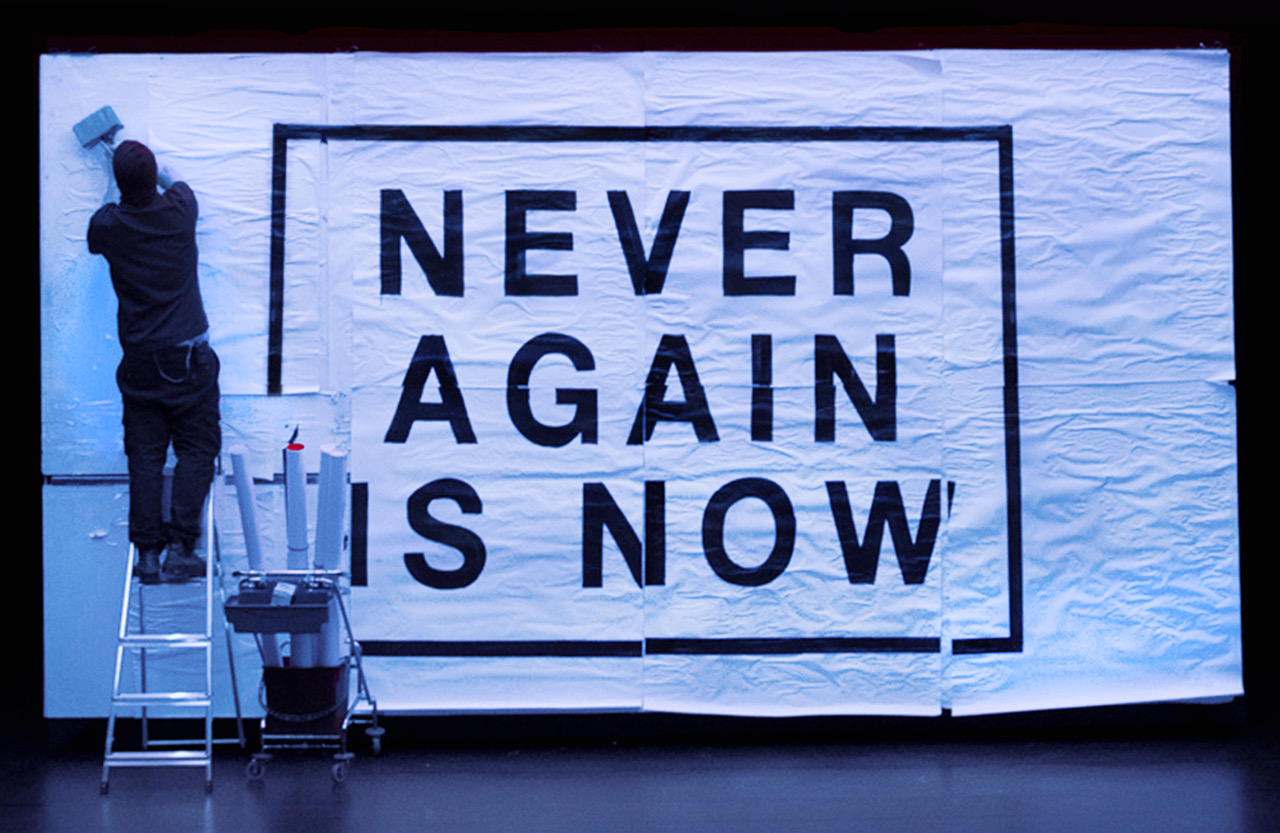
My cultural identity is shaped by German history and the admission of historical guilt toward the Jewish people, and I know this past is not simply “over.” We look at the present through the rearview mirror. We move backward into the future. There is a clear connection between a violent past and a violent present. And for that very reason, we must not use one genocide to legitimise another. Never Again is Now.
To take a critical stance against the politics of Israel – a state founded in the wake of the Holocaust – causes deep unease among many descendants of perpetrator nations. And yet, considering that for years now Palestinian people have endured occupation, displacement, land theft and devastating military assaults, it is absurd to focus solely on the acts of the oppressed – instead of demanding an end to their oppression. That the Israeli military is committing genocide has been documented by a UN-appointed panel of experts. And the fact that we must take a stand against this – based on the very human rights that also Germany has pledged itself to uphold – is our duty.
I have lived in the Netherlands for over ten years. I work in an international team and try to explain what it means to be German – and the responsibility that comes with it – not always successfully. We recently debated whether to sign a call for a cultural boycott of Israel, initiated by Belgian and Dutch activists. In the end, largely due to my critical input, we chose not to sign. A cultural boycott is to not only a refusal to offer support — this gesture also entails withdrawal from all forms of exchange. I fear that, in the end, a boycott would weaken precisely those critical forces that make change possible in the first place. Polarisation benefits those who profit from division. Therefore, we must keep the channels of communication open at all costs. I am convinced that culture is a form of exchange and that dialogue is essential. In conversations with my team, I realise how the discourse here is conducted against a different backdrop than it is back home, and I struggle to defend a nuanced position — seeing how this isolates me. At the same time, I often feel like a stranger in Germany – especially when it comes to speaking about Israel and Gaza. In the current political climate, almost any critical statement regarding Israeli policy risks being labeled as false or antisemitic. The public discourse seems highly emotional, often detached from facts, dominated by mistrust and fear. So voices fall silent – even those who are usually outspoken – especially in the cultural sector, where where many rely on public funding.
My team and I also receive state funding and work closely with public institutions, both in Germany and in the Netherlands. Friends and colleagues from home have advised me to be careful, to lie low for a while and to focus solely on my artistic work. So for two years we’ve been weighing risks, simulating “what-if” scenarios, choosing words. I live in a state I can only describe as: The Zone of Interest.
Germany and the Netherlands are among the last European nations to remain loyal to the Israeli government – despite a UN report accusing Israel of genocide in Gaza, and despite an international arrest warrant issued by the ICC against Benjamin Netanyahu for war crimes. Recently, more than 250,000 people took to the streets in Amsterdam, drawing a red line against the war, while the German government continues to approve large-scale weapons exports to Israel – weapons used to level Gaza to the ground. Roughly one-third of the weapons used in Gaza are made in Germany.
The war is a master from Germany.
Art is a tool to sharpen thought – and a weapon in the fight for free thinking. Theatre is a place of freedom, of ambiguity, a space for speculation, for dialogue and for the creation of empathy. In my work and on stage, I engage with political realities and I try to better understand the world we live in. We speak of the normalisation of violence, of social polarisation, and of the role of the audience. For years, I have been preoccupied with the paradox of the spectator – who is also a witness.
We all know what happened on October 7, 2023. And we know what has happened in Gaza since. We are witnesses to a genocide. And those who remain silent are complicit. If we fail to take responsibility now – to act – we won’t just be bystanders. We risk losing our humanity.
I deeply hope this ceasefire will hold, that the hostages can return, the prisoners will be freed, that the military will withdraw from Gaza, and that justice and peace will prevail. The fight for justice has only just begun, and we must find clear words as we come to terms with this catastrophe.
I no longer want limit my engagement to the “safe stage” of the theatre. In art, we often speak of creating “safe spaces” – but those no longer exist. Not in theatre. And certainly not in Gaza. The concept of “safe spaces” is obsolete. What we need now are brave spaces – spaces of courage, of civil disobedience, of clarity. Places where we name what is happening. Where people find the strength to stand up – to oppose injustice and rising fascism. Let us turn the theatre – and the world – into a stage where we dare to speak the truth. We must break open the frame of what is “possible” – and take to the streets. We must update the narratives we’ve inherited from our past, because otherwise they block our present – and with it, the path to justice and peace.
I once asked my grandparents what they did during the Nazi era – and why Hitler’s Mein Kampf was still sitting in their bookshelf. Today I know: I probably wouldn’t have stood up either. I would have waited too long, watched too silently – to protect my own interests, to preserve the luxury of seeking a “nuanced” position. But now I ask myself: What am I doing today? Was it anywhere near enough? And what will I tell my children when they ask?
My daughter has learned to walk – while children in Gaza have lost their legs. I hope that one day I can look her in the eyes – and say: I did not remain silent.
Julian Hetzel